> For the complete documentation index, see [llms.txt](https://docs.debio.network/llms.txt). Markdown versions of documentation pages are available by appending `.md` to page URLs; this page is available as [Markdown](https://docs.debio.network/getting-started/how-to-bridge-your-usddbio-and-usdusdt-to-the-debio-network-appchain.md).
# How to Bridge Your $DBIO and $USDT to the DeBio Network Appchain
$DBIO is a native token on the NEAR Protocol but [compatible with a Substrate-based chain](https://blog.debio.network/dbio-follows-the-substrate-standard-and-the-farm-reaches-an-all-time-high-apr-in-ref-finance-e1f8ae7900e4) thanks to the Octopus Network bridge. This also applicable for $USDT.e (a token representing USDT on NEAR Protocol that was bridged from the Ethereum blockchain via the Rainbow Bridge). inside The Octopus Network bridge transfers value from a native NEAR Protocol token into their Appchains. Every Octopus Network Appchain is a Substrate-based chain because Octopus Network is built on top of Substrate for interoperability purposes.
## Bridge Your Funds From ETH to DBIO/USDT
If you want to bridge your funds from Ethereum to DeBio Network, you must follow a few steps.
**TL;DR** You can follow the steps outlined in the image above. For a more detailed explanation, you can read the steps below.
1. [Create a Polkadot Address](#0f65)
2. [Bridge from ETH to NEAR](#9d68)
3. [Exchanging $NEAR with $DBIO](#8a1a)
4. Exchanging $NEAR with $USDT.e
5. [Bridge From NEAR to the Appchain](#8ab2)
6. [View the Funds via Octopus Bridge](#view-the-funds-via-octopus-bridge)
7. [View the Funds via Appchain](#view-the-funds-on-the-appchain)
### Create a Polkadot Address
First, download the Polkadot.js extension and create a Substrate account.
### Bridge From ETH to NEAR
$DBIO is a native NEAR Protocol token. Using NEAR’s Rainbow Bridge, you need to bridge your Ethereum assets to the NEAR Protocol. The [Rainbow Bridge](https://ethereum.bridgetonear.org/) is a native ETH ↔ NEAR Bridge built by NEAR Protocol.
[Rainbow Bridge](https://ethereum.bridgetonear.org/) doesn’t physically transfer tokens between networks and instead utilizes a [smart contract](https://learnnear.club/how-the-near-rainbow-bridge-works/) to lock tokens on the Ethereum ecosystem and mint them on NEAR.
The NEAR Protocol already provides resources for you to use the [Rainbow Bridge](https://ethereum.bridgetonear.org/):
* You can check out an in-depth video walk-through on how to bridge your funds from Ethereum to NEAR [here](https://www.youtube.com/watch?v=zbmnITYLE-M).
* You can learn more about how [Rainbow Bridge](https://ethereum.bridgetonear.org/) works[ here](https://learnnear.club/how-the-near-rainbow-bridge-works/).
### Exchanging $NEAR with $DBIO/ $USDT.e
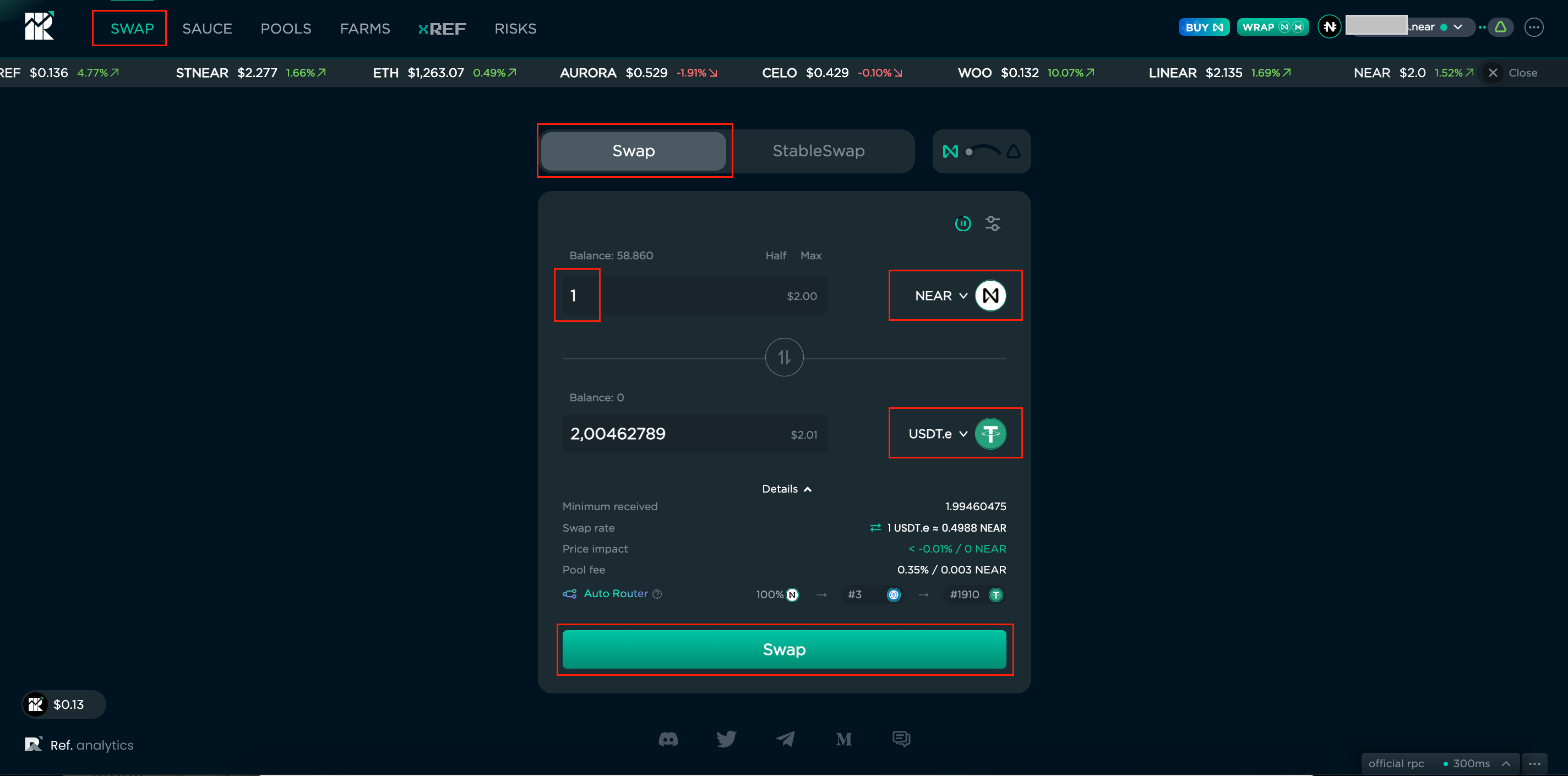
After you have bridged your funds to NEAR from Ethereum, you can use Ref Finance to exchange it with $DBIO tokens provided by the liquidity pools.
In the top right of the Ref Finance dashboard, click on the **“Connect to Near”** button.
exchange $NEAR with $DBIO
exchange $NEAR with $USDT.e
Go to the Swap page by:
1. Clicking the **“Swap”** button on the navbar.
2. Choose $NEAR as your first token.
3. Choose $DBIO or $USDT.e as your second token.
4. Set the amount of $NEAR you want to bridge
5. Click **Swap**.
### Bridge From NEAR to the Appchain
To use your tokens within the DeBio Network Appchain, you need to bridge using the [Octopus Network bridge](https://mainnet.oct.network/bridge/near/debionetwork).
You need to:
1. Put the amount of $DBIO / $USDT.e you want to bridge.
2. Set your target address.
3. Click the **“Transfer”** button.
succeed page
### View the Funds via Octopus Bridge
### View the Funds on the Appchain
You can open to check whether your funds have been bridged to the Appchain.
Click on the Polkadot logo on the far upper left corner.
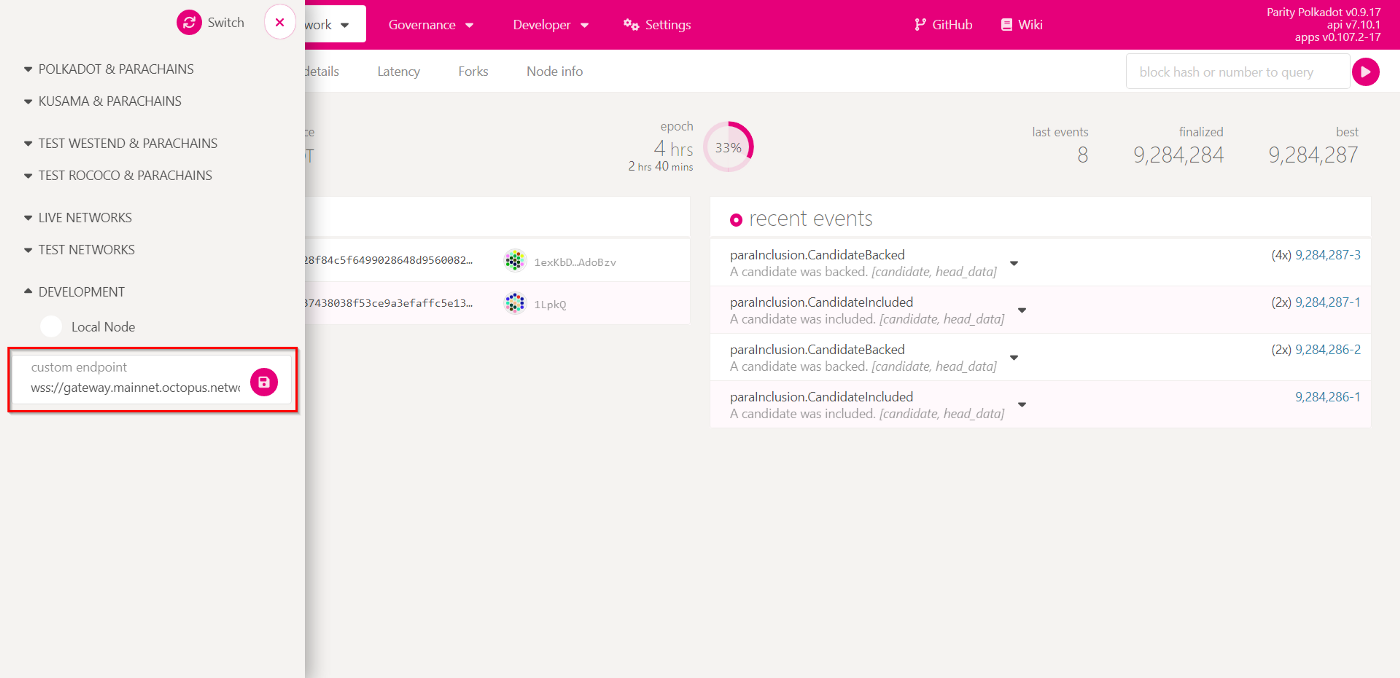
To view the DeBio Network Appchain:
1. Scroll to the bottom of the page.
2. Find the **Custom Endpoint** textbox.
3. Insert the DeBio Network Appchain Mainnet Url **(wss\://gateway.mainnet.octopus.network/debionetwork/ae48005a0c7ecb4053394559a7f4069e)**.
4. Click the 💾 button.
Next, to check the $DBIO balances:
1. Hover the **Account** header.
2. Click the **Accounts**.
3. See the balances on the table
Next, to check the $USDT balances:
1. Hover the **Developer** header.
2. Click the **Chain State**.
3. See the balances on the table
.jpg?alt=media&token=b329af81-e790-4106-969c-0ce8045e9f6b)